

Article Abstract:
Die Glasfaserkreisel (FOG) is a solid-state sensor that measures the rotation of the Earth in terms of degrees, minutes, and seconds. This technology is fundamental to modern inertial navigation systems, aerospace guidance, autonomous vehicles, and precision industrial motion control.
Unlike mechanical gyroscopes or micro-electromechanical systems (MEMS), fiber optic gyros are built without moving parts and rely instead on the Sagnac effect, an optical phenomenon that was first described in the early 20th century.
According to the foundation’s works by Georges Sagnac, and the subsequent extensive analyses published in IEEE’s Journal of Quantum Electronics, Applied Optics, and Optics Letters, fiber optic gyros have a high degree of accuracy, long-term stability, and exceptional reliability in the measurement of the phase difference between two counter-propagating light streams in a coil of optical fiber.
Based on authoritative literature like Lefèvre’s The Fiber-Optic Gyroscope, Kayton’s Systems of Navigation, and scientific research from SPIE and IEEE, this article describes in detail what a fiber optic gyro is, how it functions, and why it’s become essential in the high-performance inertial sensing field.
Introduction: Why Fiber Optic Gyros Matter in Modern Navigation
Inertial sensing is the core of motion, guidance, and stability systems. Whether it’s guiding an aircraft through turbulent air, maintaining a satellite in low Earth orbit, or allowing autonomous vehicles to function in environments that don’t have GPS, accurate measurement of the angular rate is essential.
Traditionally, this position was occupied by mechanical gyroscopes, which utilized rotors that spun on precise bearings. While beneficial, these devices had wear, friction, and sensitivity to shock that was detrimental.
The rise of the fiber optic gyro represented a significant change in paradigm. By replacing the motion of mechanical parts with the propagation of light, the fiber optic gyros removed many of the fundamental impediments associated with mechanical movement.
This transition increased the efficiency of the system, but it did not simply provide increased durability. It unlocked new levels of precision, reliability, and scalability in different industries.
Today, fiber optic gyro technology has attained a unique position between high-end ring laser gyros (RLGs) and low-cost microstereotactic gyros. It has a powerful combination of accuracy, consistency, and cost of life cycle, making it a popular solution in aerospace, defense, marine science, and, more generally, industrial automation.
What Is a Fiber Optic Gyro?
A fiber optic gyro is an optical sensor that calculates the rotation by observing the phase differences between two light streams that are traveling in different directions through a helical fiber.
The operating principle is derived from the Sagnac effect, which produces a detectable phase shift that is proportional to the rate of rotation of the coil’s fiber.
Unlike traditional gyroscopes, a fiber optic gyro lacks mechanical components that rotate. The sensing element’s core is a long stretch of optical fiber that is wound into a compact coil.
Light from a coherent source is split into two beams that travel across the coil in counter-clockwise (CCW) and clockwise (CW) directions before being combined at a photodetector.
The resulting pattern of interference encodes the exact information about the angular velocity, which enables the measurement of real-time rotation with exceptional consistency.

Historical Development of Fiber Optic Gyro Technology
The basis of the fiber optic gyro’s conceptualization can be traced back to Georges Sagnac’s 1913 experiment, which demonstrated that shaking an interferometer caused a difference in the phase of the light waves that were counter-propagated.
While initially discussed within the context of debates regarding the nature of the luminiferous aether, the Sagnac effect was later recognized as a phenomenon that is consistent with Einstein’s special relativity theory.
The practical application of this effect to gyroscopes was only possible in the latter half of the 20th century, following the development of low-loss optical fibers, semiconductor light sources, and photonic components.
The 1970s and the 1980s were characterized by intense research in aerospace and defense fields, which led to the first practical application of fiber optic gyros in the commercial sector.
Since then, improvements in fiber manufacturing, digital signal processing, and integrated optics have led to an increase in performance while decreasing size, weight, power consumption, and cost.
The Sagnac Effect: Physical Principle Behind Fiber Optic Gyros
The center of every fiber optic gyro is the Sagnac effect, which describes the way rotation affects the propagation time of light that travels in different directions around a closed loop.
When the fiber coil is still, the CW and CCW light beams follow the same optical path and intersect in a phase.
However, as the coil moves, the total path length experienced by each beam is altered slightly. One beam must have a longer distance to travel, and the other must have a shorter distance compared to the rotation frame. This discrepancy produces a significant phase shift.
Mathematically, the phase shift in the Sagnac configuration is equal to the fiber’s coil area plus the light source’s wavelength. This direct proportionality facilitates the conversion of optical phase information into exact rotational measurements.
Crucially, the Sagnac effect is independent of the fiber’s refractive index, which makes the measurement inherently resistant to many environmental changes.
Core Components of a Fiber Optic Gyro System
A fiber optic gyro that is designed today is an optoelectronic system that is composed of multiple critical components:
- Light Source
Typically, a superluminescent diode (SLD) or laser with a broadband spectrum, the light source must have sufficient coherence while minimizing noise and back-reflection sensitivity.
- Fiber Balls
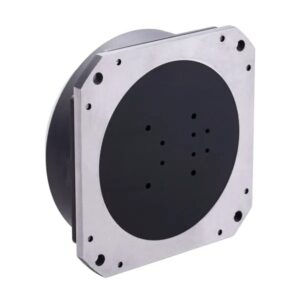
The coil of fibers is the sensing device. Its length, diameter, pattern of winding, and type of fiber directly affect the sensitivity and noise quality. The polarization-maintaining fiber is typically employed to correct for polarization-related errors.
- Optical Joins and Dividers
These components are dedicated to dividing and recombining light streams with a precise degree of control over intensity and phase.
- Phase modulating
A phase modulator employs controlled phase shifts that allow for closed-loop operation and increased linearity and range.
- Photodiodes and electronic components for signal processing
The photodetector converts optical stimulation into electrical signals, which are then processed using digital methods to acquire information about the angular rate.
How a Fiber Optic Gyro Works: Step-by-Step Explanation?
The procedure of operating a fiber optic gyro can be described as a series of clearly defined processes.
First, the light from the source is split into two equal-sized beams. These beams are inserted into the opposite ends of the fiber coil; this ensures that the coil travels in the opposite direction.
As the light traverses the coil, any alteration of the system’s rotation will lead to a phase shift in the Sagnac phase between the CW and CCW beams. After recombination, this phase difference is manifested as a shift in the pattern of interference that is observed by the photodiode.
The electrical signal resulting from the demodulation and processing is then analyzed to determine the magnitude and direction of rotation.
In fiber optic gyros that are closed, a signal that counteracts the phase difference is applied to null the difference, and the output measurement is then the feedback magnitude. This method promotes linearity, bandwidth, and long-term consistency.
Open-Loop vs. Closed-Loop Fiber Optic Gyros
Fiber optic gyros are typically categorized into open-loop and closed-loop designs, each having its own benefits.
- Fiber Optic Gyros with an open loop
Direct measurement of the interference signal is employed in open-loop designs. They’re simpler and less expensive, but they have a limited dynamic range and a nonlinearity that is high in rotation.
- Closed-Loop Fiber Optic Gyros
Systems with closed loops utilize active phase regulation to equalize the phase difference to zero. This design offers superior accuracy, a larger dynamic range, and a more stable temperature, all of which make it the most popular choice for high-end applications.
Performance Metrics of Fiber Optic Gyros
Several critical factors describe the capabilities of a fiber optic gyrator:
Bias Stability: The long-term decline in the output when no rotation is present.
Scale Factor Accuracy: The correspondence between the output of the scale and the actual rotation rate.
Angle’s Walk (ARW): A metric for the degree to which noise leads to error over time.
Dynamic Range: The maximum practical rotation rate that doesn’t lead to saturation.
High-performance optical fibers that are capable of achieving a bias that is less than 0.01°/hr are positioned in the high-endurance sensor category.
Comparison with Other Gyroscope Technologies
- Fiber Optic Gyro versus Mechanical Biorobots
Mechanical gyros have a spinning mass that causes them to be susceptible to damage and wear. Fiber optic gyros have a longer lifespan and superior reliability.
- Fiber Optic Gyro versus Micro-Electro-Mechanical (MEMS) Gyro
MEMS gyros are successful in terms of cost and size, but they lack the resolution necessary for precise navigation. Fiber optic gyros have a significantly greater degree of accuracy and consistency.
- Fiber Optic Gyro Versus Ring Laser Gyro
Laser gyros that ring have a high cost and complexity, but are also highly accurate. Fiber optic gyros are more compact and have a more cost-effective alternative for many applications.
Key Advantages of Fiber Optic Gyros
The increasing popularity of fiber optic technology for gyrovision is attributed to several beneficial aspects:
No moving parts, which results in a high degree of reliability.
Wonderful resistance to shock and vibrations.
Large operating temperature range
A long-term operational commitment that requires minimal maintenance.
Advantages include the ability to scale performance through fiber length and coil design.
Typical Applications of Fiber Optic Gyros
Fiber optic gyros are employed in a variety of different industries.
Aerospace: Inertial flight systems, reference systems for attitude
Defense: The guidance of Missiles, the stabilized platforms of weapons.
Marine: The ship’s navigational system, adaptive positioning.
Energy: Gas and oil exploration and drilling
Industrial Automation: Robotics, precision motion control
Table: Fiber Optic Gyro vs. Other Gyro Technologies
| Technologie | Genauigkeit | Bewegliche Teile | Cost Level | Typische Anwendungen |
| Mechanischer Kreisel | Hoch | Ja | Hoch | Legacy aerospace |
| MEMS-Gyro | Low–Medium | Nein | Niedrig | Unterhaltungselektronik |
| Faseroptischer Kreisel | Hoch | Nein | Medium–High | Aerospace, marine |
| Ring Laser Gyro | Sehr hoch | Nein | Sehr hoch | Strategic navigation |
Manufacturing and Design Considerations
Creating a high-quality fiber optic gyro is dependent on precise control of the fiber’s tension, coil symmetry, and thermal isolation. Even small imperfections can lead to non-reciprocal phase errors that adversely affect the accuracy.
Innovative designs employ patterns of windage, digital temperature compensation, and isolation structures that minimize the likelihood of error.
Future Trends in Fiber Optic Gyro Technology
Future research is intended to diminish the size and expense while still maintaining quality. Integrated photonics, enhanced signal processing, and hybrid FOG-MEMS systems are all considered to be promising avenues.
As autonomous systems increase in number, demand for dependable, GPS-robust navigation will continue to promote the development of fiber optic gyros.
FAQ: Fiber Optic Gyro
What is the purpose of a fiber optic gyro?
A fiber optic gyro is employed to measure the rotation of the Earth in inertial navigation, stabilization, and motion control that necessitates high accuracy and reliability.
How does a fiber optic gyro operate?
It functions by observing the phase differences between the light beams that counterpropagate in an optical fiber coil, based on the Sagnac effect.
Is it more effective to use a fiber optic gyro instead of a traditional, mechanical gyro?
For extremely precise and long term stability, fiber optic gyros are superior to mechanical gyros, although mechanical devices are smaller and more cost-effective.
Does the fiber optic gyro have moving components?
No. Fiber optic gyros are mechanical-free devices that enhance the durability and life of the device.
What industries have the greatest reliance on fiber optic technology?
Aerospace, defense, marine transportation, energy exploration, and industrial automation are the primary consumers.
Schlussfolgerung
The fiber optic gyro is considered one of the most significant advances in inertial sensing technology over the past century.
Instead of using mechanical motion to generate movement, it harnesses the fundamental principles of optical physics. This results in a unique combination of precision, consistency, and longevity.
For industries that want to have a dependable, motion-sensing, and navigational system in extreme environments, fiber optic gyros are not merely an alternative, but are often the most effective solution.