


Abstract:
Accelerometers are the fundamental components of many modern industrial, automotive, aerospace, consumer electronics, and condition monitoring systems.
Among the most commonly embraced technologies are accelerometers based on the principle of magnets, the motion of which is converted into electrical signals, and piezoelectric accelerometers, which utilize a different physical principle.
MEMS accelerometers have the greatest degree of success in low-power, high-conégration markets, while piezo accelerometers still provide the highest frequency, most dynamic measurement of vibrations.
This article provides a comprehensive, sector-specific comparison of MEMS and piezoelectric accelerometers that focuses on the structure, principles of operation, performance metrics, behavior of signals, environmental limitations, and practicality in real-world applications.
Introduction: Why the MEMS vs Piezo Accelerometer Question Matters
The query “What’s the distinction between MEMS and piezo accelerometers?” is not academic: it’s an actual engineering decision that directly affects the accuracy, reliability, cost, and lifespan of a system.
In the monitoring of vibrations, inertial navigation, structural health monitoring, safety in driving, and the monitoring of IoT, the misuse of accelerometers can result in falsified data, early failure, or extra complexity. Despite this, many online articles simplify the comparison into a few significant points; they fail to discuss the behavior of frequency, the conditioning of signals, long-term stability, or practical constraints in real life.
Engineers are studying the different ways to sense things
The process of obtaining supplies or integrating systems.
Technical marketers and product managers who specialize in building content that is driven by specifications.
This article addresses all three of these by going beyond surface-level comparisons and providing specific, physical explanations that are anchored in recognized literature.
What Is an Accelerometer?
An accelerometer is a device that calculates the magnitude of acceleration, which can be caused by motion, vibrations, gravity, or shock. These forces are typically expressed in one or several vectors and converted to an electrical signal.
Accelerometers are categorized by the mechanism they use to transduce motion, which affects the way mechanical energy is converted to electrical energy. MEMS and piezoelectric accelerometers are both important and popular categories.
Overview of MEMS Accelerometers
A MEMS accelerometer (also known as a Micro-Electro-Mechanical Systems accelerometer) is a microfabricated sensor that calculates acceleration using small mechanical structures that are etched into silicon.
The fundamental composition of aMEMS accelerometer is
A common accelerometer for MEMS has a typical composition of:
A small-scale demonstration of the proof of the concept
Hanging by flexible or spring-based mechanisms
Capable of sensing pressure, temperature, or humidity, these elements are also piezoresistant.
Integrated electronic signal conditioning
According to Analog Devices’ MEMS Sensor Fundamentals, the company’s accelerometer technology is based on semiconductor manufacturing methods that result in high productivity, consistency, and versatility.
How a MEMS Accelerometer Works?
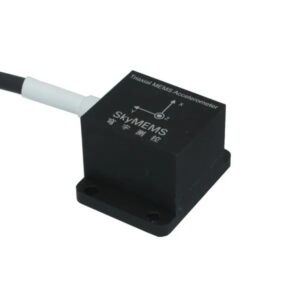
A MEMS accelerometer employs micro-sized mechanical structures that are etched onto Silicon wafers.
- Core Working principle: Capable sensing
Many MEMS accelerometers utilize a capacitive mechanism based on Newton’s second law (F = ma).
When a force is exerted on the accelerometer:
A microscopic example of a proof mass that moves with respect to fixed electrodes is provided.
This motion alters the capacity
The alteration is converted into an electrical message.
- Key Internal Components
Silicon’s safety
Micro-bulges ( suspension pillars)
Rigid and mobile electrodes
On-chip power conditioning and an ADC are both possible.
- Generation of Signals
The acceleration of the object causes the mass to be displaced.
The capacitance of the electrodes varies.
On-chip electronics recognize the change in capacitance.
The signal is enhanced and converted to a digital format.
The output is comprised of static and dynamic acceleration.
- Performance Traits
Can measure the static force (gravity)
Low power consumption
Compact and lightweight
Effective for large volume production.
Lower frequency response that is comparable to piezoelectric sensors.
- Common Examples
Smartphones and portable devices
Airbags for cars and car stability systems
Automatons and drones
The connection between the IoT and consumer electronics.
Navigational and tilt-sensing capabilities
Overview of Piezo Accelerometers
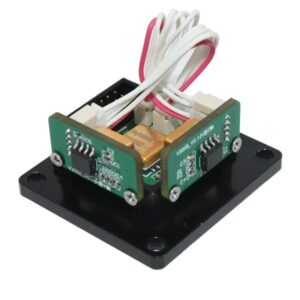
A piezo accelerometer employs the piezoelectric principle, which involves certain crystal materials generating an electrical charge when pressured.
The fundamental composition of a Piezo accelerometer is
A piezoelectric accelerometer typically has:
A piezoelectric crystal (quartz or ceramic)
A large earthquake
A solid housing
External or internal voltage/charge amplifier
Unlike accelerometers made of Silicon, piezo devices are not microfabricated structures but instead are precision mechanical assemblies.
How a Piezo Accelerometer Works?
A piezoelectric accelerometer employs the piezoelectric effect to convert mechanical energy into an electrical signal.
- Core Working Principle: Piezoelectric Effect
Certain substances (such as quartz or piezo-ceramics) produce a charge of electricity when pressured.
When a force is exerted on the accelerometer:
A large amount of seismic energy is transferred to the piezoelectric component.
This induces a distortion in the crystal.
The deformation creates an electric charge that is proportional to the acceleration.
- Key Internal Components
Piezoelectric crystal (quartz or ceramic)
Seismic (test) population
Mechanical structure (bending, shearing, or compression)
Charge amplifier or electronic charge
- Generation of Signals
External acceleration has the effect of increasing the seismic mass’s inertia.
The pressure is transferred to the piezoelectric crystal.
Crystal’s electric field creates a charge.
Electronics transform the charge into usable voltage information.
The output is directly related to the dynamic acceleration.
- Performance Traits
Excellent low-frequency response
Extremely low sound
High temperature tolerance
Only measures the acceleration of the object in its current state
❌ Can’t measure the static or low-frequency acceleration (e.g., gravity)
- Common Examples
Vibration and shock detection
Conditioning of machinery with a rotating head
Automotive and aerospace testing
Structural health monitoring
Piezo vs MEMS Accelerometer: Working Principle Comparison
| Aspect | Piezo Accelerometer | MEMS Accelerometer |
| Sensing method | Piezoelectric charge generation | Capacitive displacement |
| Measures static acceleration | ❌ No | ✅ Yes |
| Frequency response | Very high | Low to medium |
| Power requirement | External electronics | Very low, often battery-powered |
| Size | Larger | Very small |
| Typical use | Industrial vibration | Consumer & embedded systems |
Fundamental Difference in Operating Principle
The primary difference between MEMS and piezoelectric accelerometers is how the accelerometer is sensed.
MEMS accelerometer: It has the capacity to measure the displacement of a micro-mass ( capable of static and dynamic measurement)
Piezoelectric accelerometer: It measures the force-induced charge in a stone (only dynamic)
This single difference is the primary cause of the majority of the observed differences in real-world applications.
Frequency Response Characteristics
The behavior of MEMS accelerometers in terms of frequency is
MEMS accelerometers have a superior performance:
Low-frequency recording
Constant or almost constant velocity
The response of the DC, including gravity, is
However, their maximum frequency is limited by the mechanical frequency and the bandwidth of the signal conditioning. While modern MEMS devices are capable of reaching several hundred kilohertz, their performance will decrease near the resonant frequency.
Piezo Accelerometer Frequency Behavior
Piezo accelerometers are intrinsically linked to AC fields and cannot differentiate between true up and down acceleration. However, they provide:
Extremely wide bandwidth response
Excellent fidelity at high frequencies
Increased signal-to-noise ratio at high frequencies.
For the analysis of vibrations, piezoelectric accelerometers are typically more effective than microsensors by a factor of two.
Sensitivity and Measurement Range
MEMS accelerometers have a wide range of sensitivities, from 1 g to 200 g or more, which makes them ideal for both motion detection and shock detection.
Piezoelectric accelerometers typically have:
Extremely sensitive to vibrations
Extremely linear behavior across a wide range of dynamic behavior.
High resistance to overload
This is beneficial to piezo devices in regard to their harsh environmental friendliness.
Noise Performance and Resolution
The ability to reduce noise is crucial to the successful performance of precision instruments.
MEMS accelerometers have a higher noise volume at higher frequencies.
Piezoelectric accelerometers have low noise that’s maintained over a wide frequency range.
In structural health monitoring or machinery that rots, this noise advantage is often significant.
Temperature Stability and Environmental Limits
MEMS Accelerometer Tolerance to Environment
MEMS accelerometers have a generally successful performance in mid-range temperatures, but:
Sensitivity may be lost
Bias stability is adversely affected by extreme temperatures.
Advanced calibration and compensation are often necessary.
Piezo Accelerometer Environment Tolerance
Piezoelectric accelerometers are inherently powerful:
Superb high-tempered performance
Advantages include its proven efficiency and effectiveness as a commercial system.
Constant long-term improvement
Quartz-based sensors that are based on piezoelectricity are particularly popular for their thermal stability.
Power Consumption and Signal Conditioning
MEMS accelerometers need constant power, but they consume little by little—typically microamps—which makes them ideal for battery-powered and other devices that have a low power consumption.
Piezo accelerometers produce a passive charge, but additional external components are required for their amplification or conditioning, which increases the complexity and power requirements of the system.
Comparative Table: MEMS vs Piezo Accelerometers
| Parameter | MEMS Accelerometer | Piezo Accelerometer |
| Measurement Type | Static + dynamic | Dynamic only |
| DC Response | Yes | No |
| Frequency Range | Low to mid (Hz–kHz) | Mid to very high (Hz–tens of kHz) |
| Power Consumption | Very low | External conditioning required |
| Size & Weight | Very small | Larger, heavier |
| Noise at High Frequency | Higher | Lower |
| Typical Applications | IMUs, IoT, automotive | Vibration, machinery monitoring |
Application-Driven Comparison
When aMEMS accelerometer is the most appropriate
A MEMS accelerometer is typically used when:
- Measuring low or static frequency motion
- Size, weight, and power are essential
- The conversion to digital and theintegration of the system is necessary
- The cost of the project is highly sensitive
Common uses include inertial guidance systems, smartphones, drones, automotive airbags, and wearable technology.
When a Piezo Accelerometer Is the Better Choice?
A piezoelectric accelerometer is most effective when:
- High-precision data regarding vibrations is essential
- Constant long-term stability is essential
- The climate is harsh or overly hot.
- The measurement accuracy is greater than the size limitations.
Typical scenarios include the monitoring of machinery, the testing of aerospace, the analysis of modes, and the diagnosis of industries.
MEMS Accelerometer Advancements and Industry Trends
Recent advances in MEMS technology related to accelerometers include:
- Enhanced noise reduction
- More powerful designs with higher bandwidth.
- Integrated sensor combination
- Increased temperature compensation
These advances have reduced the gap with piezoelectric accelerometers in some instances of vibration; however, fundamental physics still has limitations.
Cost and Lifecycle Considerations
MEMS accelerometers are scale-free due to the semiconductor’s economies of scale, which leads to:
- Lower prices
- Easy to replace
- More rapid design processes
Piezo accelerometers are typically more expensive, but they have a longer lifespan and can be used in demanding industrial systems that have a longer lifespan, all of which results in a total cost of ownership.
Common Misconceptions
Myth: that the accelerometer in the MEMS is completely replaceable by the piezo.
Reality: Each has a distinct frequency and special application areas.
Legacy: Piezo sensors for acceleration are no longer relevant
Reality: They still have an important role in high-precision noise analysis.
Myth: MEMS accelerometers are less accurate.
Reality: Accuracy is influenced by the context of measurement, not just the technology itself.
FAQ: MEMS and Piezo Accelerometers
What is the main difference between MEMS and piezo accelerometers?
The primary difference is their principle of sensing: MEMS accelerometers are based on the principle of mass displacement, while piezo accelerometers are derived from the piezoelectric effect and can detect static as well as dynamic forces.
Can a microstereometer measure vibrations?
Yes, butMEMS accelerometers are typically more effective at measuring low to mid-range vibrations than piezo accelerometers.
Why can’t piezoelectric accelerometers measure the static force?
Because the piezoelectric effect only creates charge when there is a change of force, static acceleration does not have a sustained effect.
Are microstereotactic accelerometers dependable for scientific use?
Yes, this is especially true of applications that have a significant impact on size, power consumption, and integration.
Which accelerometer is more effective for monitoring conditions?
Piezo accelerometers have a typically higher response than other instruments because of their superior noise and high-frequency capabilities.
Conclusion
What is the distinction between MEMS and piezoelectric accelerometers?
The discrepancy is based on physics, not advertising. A MEMS accelerometer is superior to a piezo accelerometer in low-power, compact design, and in static measurement scenarios that are not prone to change, while a piezo accelerometer is still lacking in terms of high frequency, high accuracy, and stability.
Instead of seeing them as adversaries, engineers should consider the MEMS and piezo accelerometers as being complementary to one another, each having their own special challenges in terms of measurement. Selecting the appropriate sensor is dependent on understanding the frequency spectrum, environmental variables, system limitations, and long-term goals.
Today’s successful sensing systems are designed with the accelerometer in mind, not the other way around.