

Quick Answer:
A MEMS angular rate sensor is a miniature inertial device that measures the rate of rotation (angular velocity) of an object via the Coriolis effect, allowing for precise tracking without external reference points.
In engineering, it is a micromachined gyroscope that senses angular rate or orientation change by vibrating structures or capacitive sensing.
The sensor converts rotation into an electrical signal proportional to angular velocity, making it the heart of modern navigation, robotics, and stabilization systems.
Introduction: Why MEMS Angular Rate Sensors Matter Today
In modern engineering systems, from smartphones and drones to autonomous vehicles and industrial robotics, accurate motion sensing is crucial. At its heart is the MEMS angular rate sensor, a small device capable of sensing rotational motion in three-dimensional space with high accuracy.
Unlike mechanical gyroscopes, MEMS-based sensors are manufactured using microfabrication, making them extremely small, low-cost, and reliable. They have been used in inertial navigation equipment to track a vehicle’s orientation without relying on GPS or external signals.
SkyMEMS has contributed to the advancement of MEMS gyroscopes for improved accuracy, less noise, and better performance for industrial and aerospace applications.
What Is a MEMS Angular Rate Sensor? (Core Definition)
MEMS angular rate sensor is an inertial device that detects the speed with which an object rotates around one or more axes. It measures angular velocity in degrees per second (°/s) or radians per second (rad/s).
Technically speaking, it is a MEMS gyroscope that utilizes micro-electro-mechanical structures to sense rotation based on Coriolis acceleration.
Formal Engineering Definition
A MEMS gyroscope is a micro-machined inertial sensor used to measure changes in angle or direction by vibrations created by the Coriolis forces.
This makes it an essential part of inertial navigation systems, where external references (e.g. GPS) may not be present or be fickle.
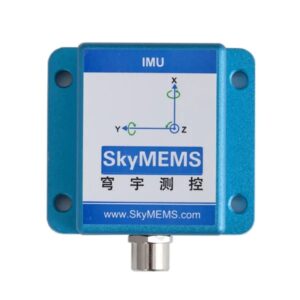
How a MEMS Angular Rate Sensor Works?
The operation of an MEMS angular rate sensor is based on mechanical vibration and force.
Step 1: Vibrating Proof Mass
Inside the sensor, a tiny mechanical device (proof mass) is vibrated in a certain direction.
Step 2: Rotation Applied
As the device turns, it experiences a Coriolis force perpendicular to its vibration and rotation axis.
Step 3: Deflection Detection
This very small angular movement can be measured with capacitive or piezoelectric sensing.
Step 4: Electrical Signal Conversion
The detected displacement is converted into an electrical signal proportional to the angular velocity.
Basically, the device converts movement into electrical output.
Physical Principle Behind MEMS Angular Rate Sensors
The key physical principle is the Coriolis effect, which occurs in rotating reference frames.
When a mass moves inside a rotating system, it experiences an apparent force perpendicular to its motion. In MEMS devices, this effect is used deliberately to detect rotation.
Mathematically, the Coriolis acceleration is expressed as:
ac=2(Ω×v)
Where:
- Ω = angular velocity
- v = velocity of vibrating mass
This relationship is fundamental to all MEMS angular rate sensors .
MEMS Angular Rate Sensor vs Traditional Gyroscope
| Feature | MEMS Angular Rate Sensor | Mechanical Gyroscope |
| Size | Micro-scale | Large mechanical system |
| Power Consumption | Very low | High |
| Cost | Low | High |
| Durability | High (solid-state) | Mechanical wear |
| Startup Time | Instant | Slow |
| Integration | Easy (IC-level) | Complex |
MEMS technology replaces spinning rotors with vibrating silicon structures, making sensors more compact and reliable.
Internal Structure of a MEMS Angular Rate Sensor
A typical MEMS sensor includes:
- Drive mass (vibration source)
- Sense mass (detects Coriolis motion)
- Suspension springs
- Electrodes for capacitive sensing
- Signal conditioning circuitry
Structure Overview Table
| Component | Function |
| Drive Mass | Generates controlled vibration |
| Sense Mass | Detects Coriolis-induced displacement |
| Springs | Maintain oscillation stability |
| Electrodes | Convert motion to electrical signal |
| ASIC Circuit | Processes and outputs angular rate |
This micro-scale architecture is fabricated using silicon wafer processes similar to semiconductor manufacturing.
Types of MEMS Angular Rate Sensors
In microelectromechanical systems (MEMS), angular rate sensors, commonly known as gyroscopes, are key components used to measure rotational motion in navigation, robotics and consumer electronics. These sensors are widely used in systems that require motion tracking and stabilisation.
Vibratory MEMS gyroscopes
Principle: Use a vibrating mass or structure to detect rotation through changes in vibration patterns caused by the Coriolis effect.
Key features:
- Most widely used MEMS gyro type
- Compact and cost-effective
- Suitable for consumer electronics
Applications:
- Smartphones
- Gaming controllers
- Drones
- Tuning fork gyroscopes
Principle: Use two counter-vibrating beams (tuning fork structure). Rotation causes an imbalance in the vibration, which is measured.
Key features:
- Better noise rejection
- Improved stability compared to basic vibratory designs
Applications:
- Automotive stability systems
- Industrial sensors
- Inertial measurement units (IMUs)
Ring Gyroscopes
Principle: Use circular or ring-shaped vibrating structures to detect rotation via changes in standing wave patterns.
Key features:
- Better noise rejection
- Improved stability compared to basic vibratory designs
Applications: Ring gyroscopes
Principle: Use circular or ring-shaped vibrating structures to detect rotation via changes in standing wave patterns.
Key features:
- High precision
- Excellent long-term stability
- Reduced drift
Applications:
- Aerospace navigation
- High-end inertial systems
- Defence applications
- Closed-loop MEMS gyroscopes
Principle: Use feedback control systems to actively correct output signals and maintain constant vibration amplitude for higher accuracy.
Key features:
- Superior accuracy and stability
- Real-time error correction
- Better performance under dynamic conditions
Applications:
- Autonomous vehicles
- Robotic navigation systems
- Precision industrial control
Final Takeaway:
MEMS angular rate sensors vary mainly by structure and control mechanism, with performance trade-offs:
- Vibratory types → low cost, widely used
- Tuning fork types → better stability
- Ring gyros → high precision
- Closed-loop systems → highest accuracy and control
These technologies form the backbone of modern motion sensing in everything from smartphones to aerospace systems.

Key Performance Parameters
| Parameter | Description | Typical Range |
| Bias Stability | Output drift over time | 5–50 °/h |
| Noise Density | Random signal noise | 0.005–0.1 °/s/√Hz |
| Range | Measurable angular velocity | ±250 to ±2000 °/s |
| Bandwidth | Response speed | 50–500 Hz |
High-end industrial sensors from companies like SkyMEMS often focus on improving bias stability and reducing noise for navigation-grade applications.
Applications of MEMS Angular Rate Sensors
In Microelectromechanical Systems, MEMS angular rate sensors (gyroscopes) are essential components for measuring rotational motion. Their compact size, low power consumption, and high reliability make them suitable for a wide range of industries requiring precise motion tracking and stabilization.
- Consumer Electronics
Typical uses:
- Smartphones (screen rotation and gesture control)
- Gaming controllers
- VR/AR headsets
Function:
Detect orientation changes and angular movement in real time
Value:
Enables intuitive user interfaces and immersive digital experiences
- Automotive Systems
Key applications:
- Electronic stability control (ESC)
- Yaw rate detection
- Autonomous driving systems
Function:
Helps vehicles maintain balance and directional stability
Impact:
Improves driving safety and supports advanced driver-assistance systems (ADAS)
- Aerospace & Defense
Applications:
- UAV navigation
- Missile guidance systems
- Aircraft stabilization
Role:
Provides accurate orientation data in dynamic and high-vibration environments
Importance:
Critical for navigation accuracy when GPS signals are limited or unavailable
- Industrial Robotics
Uses:
- Motion control systems
- Precision positioning
- Factory automation
Function:
Ensures accurate movement and alignment of robotic components
Benefit:
Enhances efficiency, repeatability, and operational precision
- Marine Navigation
Applications:
- Underwater vehicle orientation
- Dead reckoning systems
Function:
Maintains navigation accuracy in GPS-denied environments
Value:
Essential for submarines, ROVs, and autonomous underwater systems
Final Takeaway:
MEMS angular rate sensors enable precise motion detection across industries by providing:
- Real-time orientation tracking
- High reliability in harsh environments
- Compact and energy-efficient performance
Their versatility makes them a foundational technology in modern consumer devices, transportation systems, aerospace, robotics, and marine navigation.
Advantages of MEMS Angular Rate Sensors
In the field of microelectromechanical systems (MEMS), angular rate sensors (gyroscopes) have become the dominant solution for motion sensing thanks to their optimal balance of performance, cost and integration capability.
- Extremely compact size
Why it matters:
Built using microfabrication techniques, they fit into very small devices and systems, enabling integration into smartphones, wearables, drones, and compact robotics. Low-cost mass production
Key factor:
Manufactured using semiconductor-style batch processes
Result:
- High scalability
- Significantly reduced unit cost compared to mechanical gyroscopes
- High reliability (no macroscopic moving parts)
Design advantage:
Uses micro-scale vibrating structures instead of large mechanical components
Impact:
- Less mechanical wear and tear
- Longer operational lifespan
- Improved shock and vibration resistance
- Low power consumption
Why it’s important:
Designed for energy-efficient operation
Benefit: ideal for battery-powered devices and extends operating time in portable systems
- Easy integration into electronic systems
Integration advantage:
Compatible with modern IC and sensor fusion platforms
Result:
Seamless use in inertial navigation systems and multi-sensor modules
Final Takeaway:
MEMS angular rate sensors dominate modern inertial sensing because they offer:
- Miniaturization
- Cost efficiency
- High reliability
- Energy efficiency
- Easy system integration
These advantages make them a core enabling technology across consumer electronics, automotive systems, aerospace, and industrial automation.
Industry Innovation: Role of SkyMEMS
Companies like SkyMEMS are actively developing next-generation MEMS angular rate sensors with:
- Improved bias stability
- Enhanced temperature compensation
- Higher signal-to-noise ratio
- Industrial-grade reliability
These improvements are critical for high-precision navigation systems used in aerospace and autonomous platforms.
Future Trends (2026 and Beyond)
In the field of microelectromechanical systems (MEMS), angular rate sensors are evolving rapidly from standalone components into intelligent, integrated sensing systems. The next generation will focus on greater accuracy, smarter calibration and greater system integration.
- AI-based sensor calibration
What’s changing:
Machine learning algorithms are used to continuously correct sensor drift and bias.
Why it matters:
- Improves long-term accuracy without manual recalibration
- Adapts to changing environmental conditions
Impact:
More reliable performance in real-world autonomous systems
- Multi-sensor fusion (IMU integration)
Concept:
Combining gyroscopes, accelerometers and magnetometers into a unified system (IMU).
Inertial navigation systems
Benefits:
- Higher accuracy in motion tracking
- Reduced limitations of individual sensors
- Improved stability in dynamic environments
- Ultra-low noise MEMS designs
Advancement:
Improved microstructure engineering reduces signal noise
Result:
- Higher precision in detecting small angular changes
- Better performance in navigation-grade applications
Use case:
Robotics, aerospace and precision industrial systems
- High-temperature industrial sensors
Trend:
Development of MEMS sensors capable of operating in extreme environments
Applications:
- Oil & gas
- Automotive engine systems
- Industrial manufacturing
Benefit: Expands MEMS usage beyond consumer electronics into harsh conditions
- Chip-scale inertial navigation systems
Innovation:
Entire navigation systems integrated into a single chip
Features:
- Extremely compact design
- Low power consumption
- Real-time motion tracking without external GPS
Impact:
Enables autonomous navigation in small drones, robots and wearable systems.
Final Takeaway:
The future of MEMS angular rate sensors is moving toward:
- Smarter (AI-driven calibration)
- More integrated (sensor fusion systems)
- More precise (low-noise designs)
- More robust (high-temperature capability)
- More compact (chip-scale navigation)
These innovations will significantly expand the role of MEMS technology in autonomous vehicles, robotics, aerospace, and intelligent sensing systems.
FAQ: MEMS Angular Rate Sensor
- What does a MEMS angular rate sensor measure?
It measures angular velocity (rotation speed) around one or more axes.
- Is a MEMS angular rate sensor the same as a gyroscope?
Yes, it is a type of MEMS gyroscope designed for angular rate measurement.
- How accurate are MEMS angular rate sensors?
Accuracy depends on design, typically ranging from consumer-grade to navigation-grade precision.
- What is the working principle of MEMS gyroscopes?
They operate based on the Coriolis effect applied to vibrating microstructures.
- Where are MEMS angular rate sensors used?
They are used in smartphones, drones, vehicles, aerospace systems, and robotics.
- What are the advantages of MEMS sensors?
They are small, low-cost, energy-efficient, and highly reliable.
Conclusion
An MEMS angular rate sensor is an essential component in the modern motion-sensing technology. It can accurately measure the rotational movement of a fixed object with micro-scale vibrating sensors and Coriolis force detection.
As industries move toward automation, robotics, and autonomous navigation, the need for MEMS inertial sensors continues to increase. Companies such as SkyMEMS continue to lead the way in advancing the accuracy and reliability of MEMS angular rate sensors, making them an integral part of next-generation navigation and control applications.